Ten-Minute Story Exercise (Monday)

To warm up for NaNoWriMo 2023 next Wednesday, I'm writing as complete a short story as I can manage each day this week—in no more than ten minutes each. Hopefully, I'll become more efficient as I repeat the exercise. Before I write, I roll three pairs of Rory's Story Cubes—one for the main character, one for the story setting, and one for the starting situation. Then, I start the timer and begin writing.

The first step is interpreting the story dice. I adapt a technique from Creating Short Fiction by Damon Knight: I quickly write down the first few ideas which come to mind to get the obvious and more boring ideas out of the way. Usually, the third or fourth idea is something that has a bit more subconscious-born creativity in it—something that surprises and excites me enough to want to write about it.
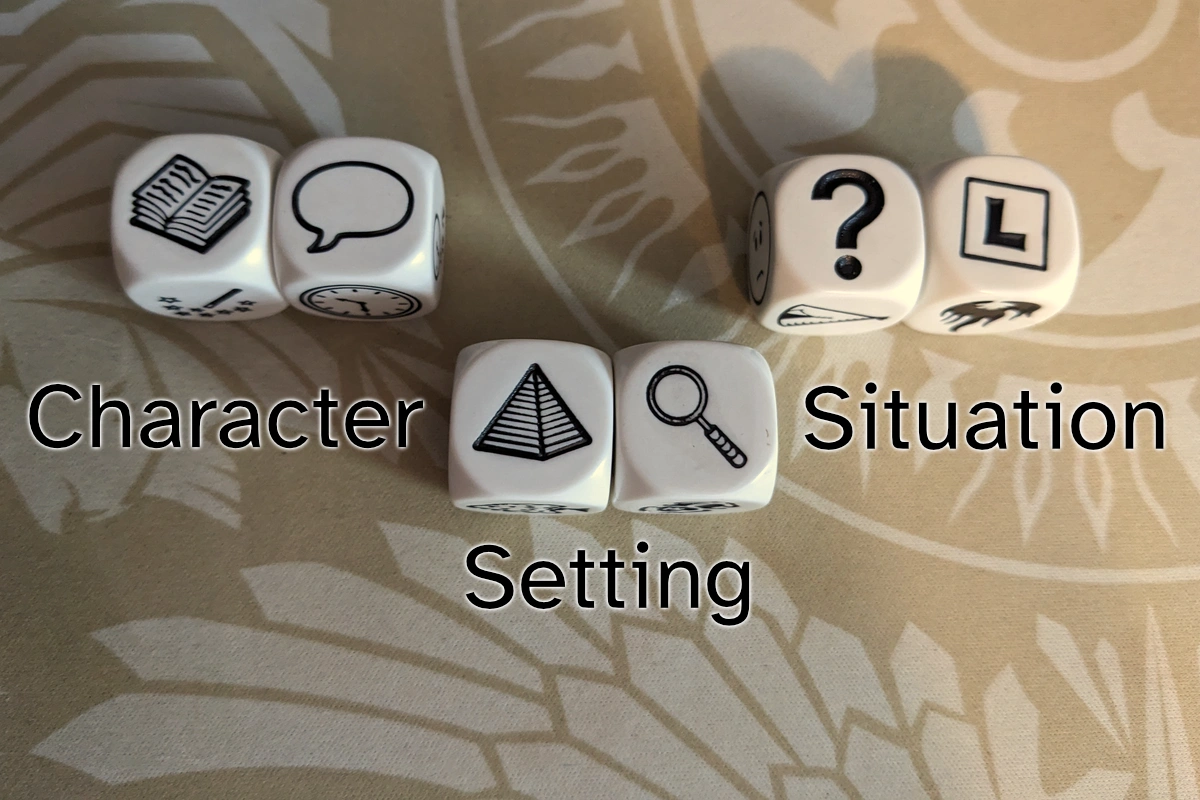
In this case, I interpreted the character to be a customer service worker with the wrong documention, the setting to be the help desk of a massive fishing supply store (inspired, of course, by one of the world's largest pyramids), and the situation to be that someone couldn't find their way out of a maze (interpreting the boxed "L" to be a maze section).

I sketched rough story outline, then began trying to fill it in. I didn't get terribly far in the ten minutes I allotted myself. It's easy to look at that whole dice process and say, "Maybe spend less time fiddling and more time writing," but frankly it took far longer to explain the process here than it did to actually do it. Hopefully the interpretation process is a few moments shorter tomorrow, but what'll be more helpful is deciding on a much simpler story without so much need for setup.


"Welcome to We Know Carp," I spat between gritted teeth. "When it comes to carp—yep, we know 'em."

I wasn't a very good customer service representitive. I shouldn't have let such a stupid situation get my goat. Yet, here I was, clenching the store phone's receiver with a hand that was, unfortunately, far too weak to shatter the ancient plastic casing.

For the eleventh time, the wheezy voice on the other end of the line said, "Yeah, that didn't work. I just ended up by the Play-Doh and Kool-Aid display again. Gettin' real tired of this, boy."

He wouldn't stop calling me. This was my first day on the job at We Know Carp's customer service desk. Was every day going to be like this? Every day, would scrungy old men call me nearly a dozen times from within the store itself, demanding I give them directions to the front door?

Sure, our four-floor mega-store devoted to all things carp fishing was a bit of a labyrinth. In fact, I'd gotten lost a few times during my orientation morning... and while my manager surely had just popped off to do some work somewhere else, I couldn't shake the feeling that I'd seen him fall into our primal koi display when I was turning to examine a massive wall of designer hot sauces. But when I'd approached said koi display and squinted suspiciously at the rippling water, my manager hadn't been there at all—only a dozen very large, very innocent-looking koi poking their heads out of the water and grinning at me with their precious little rows of teeth.

Orphans and Moon Sheep

Last night, I finished playing a D&D 5e campaign in the Eberron setting—a campaign that had run for over three years. Our DM recorded all two hundred sessions of the campaign, and you can watch them here.

I played the pirate queen Clemence Splitstream (Eldritch Knight 8 / War Wizard 12) and had tremendous fun blasting monsters with lightning and arrows alongside my friends.

After the curtains rolled on this three-year adventure, each player presented an epilogue of their reincarnated characters in their next lives. I now present to you a sliver from the life of Clementine, a nomad who has enjoyed a much less interesting life than his former self.


"Finish your chores," said Clementine. "Moon sheep won't milk themselves."

"In a minute," said Hans.

Clementine glared at him. "Boy," he said.

Hans went pale. He sprang up from his dice game on the floor and ran out of the tent and into the night.

Clementine grumbled and took up the cheese loom that had been soaking up the sun's energy all day. He poured the last night's harvest of moon milk into the hopper, pressed rhythmically upon the pedal with his good foot, and began weaving cheese from the crossed energies of the sun and moon.

The other orphans were long since asleep. They were all much younger than Hans.

Clementine felt a pang of guilt. Hans begrudged all of them—Clementine and Miranda and all Hans's fellow orphans of the plains—for it was only Hans who had to do the haunting work of wrangling astral ovines and stealing their nourishing fluids, night after night. It was unfortunate that there was no other option. Unfortunate, too, that Clementine couldn't spare the hour to go with Hans each night.

There was just so much work to do every day, every night, just to keep everyone fed and warm and safe. Every seer their ramshackle family met said the same thing—you'll find civilization, a home where children can thrive, some day soon.

Soon. They'd been looking forward to "soon" for over five years, back when Hans had been a toddler, the only orphan in Clementine and Miranda's care.

Five long years of an inexplicable sort of contract handed down by heaven to everyone their family met. Tribe, clan, or village—whenever their family met a band of others, the patriarch or elders or council had the same request: "Our seer told us you were coming. We have an infant with no parents. It has refused to eat for days, nearly dead. Please, if it will eat for you, will you take the child with you?"

Each time, the infant had greedily swallowed the milk of moon sheep—the strange creatures which only seers could see.

Seers, and Hans.

And unlike the seers, Hans could also touch them.

Clementine was tired. There were far too many children. They deserved a better life than this. They deserved the kind of life people used to live, like in the city where Clementine himself had grown up... though that city was long gone.

The seers claimed Clementine would see a city again, would find a home for all the abandoned children of the plains.

And now it had been over a year since they'd seen another soul—

A scream in the night.

Clementine left the loom and rushed from the tent. Miranda stuck her head out of the youngest children's tent, eyes wide. "Hans!" she called.

"I've got him!" Clementine snapped, stooping only to snatch up his polished walking staff as he ran. "Shillelagh," he whispered, and touched the single bud on the long-dead branch. Green thorns, pale in the moonlight, sprang from the wood as the bud blossomed in a toxic spray. The thorns dug greedily into Clementine's arm, and the poison traded places with his blood.

"Speed," he whispered. "I give you my life; now give me speed!"

The poison reached his heart, and Clementine's muscles exploded with new energy.

And all the while, Hans's screaming continued.

Clementine crested the dune and beheld the scene.

Silver blood was sprayed everywhere: the blood of moon sheep, visible and tangible like their milk once it left their bodies.

No corpses.

No, for Hans, savaged and torn, still screamed.

A six-legged, two-headed wolf had pinned him to the ground. Its heads were snapping at each other for the honor of tearing out his throat.

And Clementine felt fear like he never had in his life.

"Strength!" he shouted. "I give you my life; now give me strength!"

More vines.

More thorns.

More poison in the blood.

He sprinted down the dune. He met the wolf.

It turned to face him, claws coated in silver and red.

Clementine was no warrior. He wasn't even really a father.

Yet, he swung.

His staff struck the wolf on one head and there was a crunch of pulverized skull. Clementine's own shoulder ligaments tore. He felt no pain.

One head limp, the wolf towered high and crashed down on Clementine, crushing and lacerating ribs with one swipe of a massive paw.

What had that same paw done to Hans?

Clementine felt his life fading. There wasn't much left to give. His vision blurred. Please, he begged inside his head, just one more. All I need... is to hit it one more time... then you can take me. I'll go with you.

He tried to raise the staff high. He could only bring his arms up to head height. He screamed.

And lightning sprang down from a cloudless sky, as though from the moon itself, and struck the staff.

Yet Clementine did not die. He swung weakly, and the lightning cascaded from his staff and pierced the monster's heart.

It exploded in a burst of light and meat.

Clementine fell to his knees, the staff dropping to the sand beside him. He took Hans in his broken arms, pressed his ear to the child's chest, and wept.

He could hear nothing. Yet... there was a vibration. Steady. For the moment.

And he wept for another reason.

In the momentary flash of light, a bit of horizon had become illuminated which had, when they'd arrived in the darkening evening, seemed like only scraggly mountains in the distance.

But the lightning had revealed them for what they were, a memory from Clementine's past.

The next day, Miranda would go off by herself toward the horizon.

And she would come back with help from the city.